NYC
Manus 2.0: AI’s Next Big Breakthrough—or the Hype Machine Strikes Again?
|Subscribe·Archives·Current Issue
Manus 2.0: AI’s Next Big Breakthrough—or the Hype Machine Strikes Again?
Manus 2.0 is turning heads—but is it AI’s next big leap or just another hype cycle?
Shinji Fuse

Shinji Fuse

Oct 13, 2026
Manus just pulled off one of the most dramatic pivots in AI startup history.

The AI agent company — which was almost sold to Meta for $2 billion — had that deal blocked by China, rebooted as an independent company, launched a new architecture cutting costs by 32%, and is now raising $500 million at a $4 billion valuation.

Oh, and they did all of this in about six months.

What Is Manus? (And Why Should NYC Operators Care?)

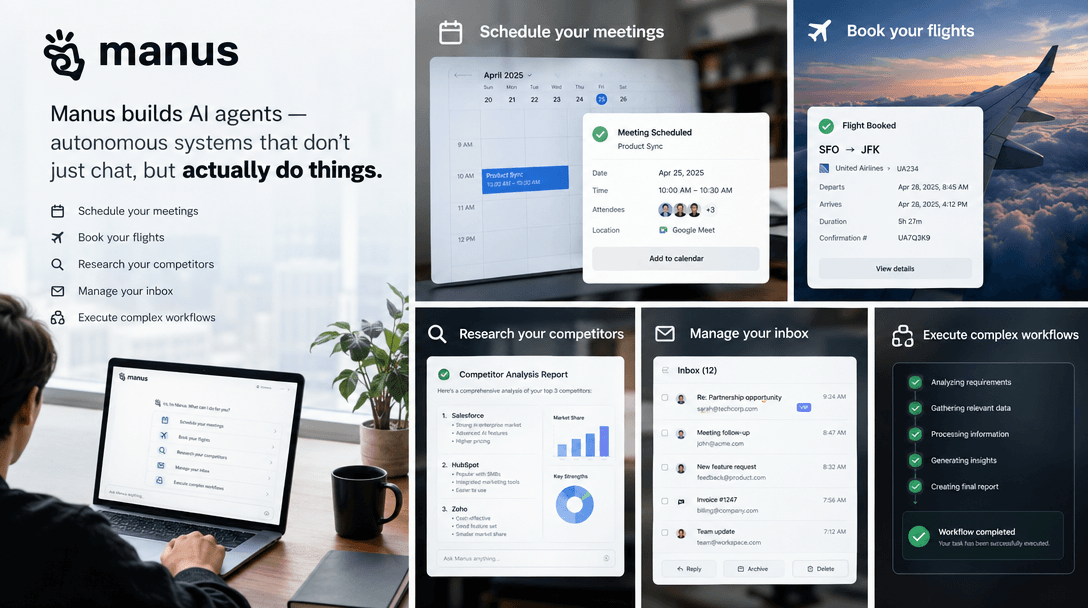
Manus builds AI agents — autonomous systems that don't just chat, but actually do things.

• Schedule your meetings
• Book your flights
• Research your competitors
• Manage your inbox
• Execute complex workflows

Think of it as hiring a digital employee that never sleeps, never calls in sick, and costs a fraction of a human assistant.

The numbers:

• $4 billion target valuation (2x what Meta offered)
• $500 million new funding round
• 32% cost reduction with new Cascade architecture
• Manus 2.0 just launched with Studio, Cloud Computer, and Cue app

The Meta Deal That Wasn't

Here's where it gets interesting.

Meta — desperate to catch up in AI — tried to buy Manus for $2 billion. The deal was announced. Champagne corks were popped.

Then China blocked it.

Chinese regulators, concerned about losing a key AI asset, killed the acquisition after a months-long probe. Meta reportedly had to unwind the deal.

Manus went from "about to be owned by Meta" to "independent and worth twice as much."

The New Architecture: Cascade

Manus 2.0 isn't just a rebrand. It's a technical overhaul.

The new Cascade architecture claims to:

• Cut operating costs by 32% — making AI agents cheaper to run
• Improve reliability — fewer errors, better task completion
• Scale more efficiently — handle more users without proportional cost increases

This matters because AI agents have been expensive to operate. If Manus can deliver on these cost cuts, it could make AI agents accessible to businesses that couldn't afford them before.

What This Means for NYC Business Owners

AI Agents Are Coming to Your Workflow
Manus isn't alone. The entire AI industry is racing toward autonomous agents that handle tasks, not just generate text. For NYC operators, this means:

• Customer service that resolves issues without human intervention
• Scheduling and logistics handled automatically
• Research and analysis done while you sleep

The Cost Curve Is Bending Down
A 32% cost reduction is significant. As AI agents get cheaper, they'll become viable for smaller businesses — not just enterprises with massive budgets.

Competitive Pressure
If your competitors adopt AI agents and you don't, they'll operate faster, cheaper, and 24/7. The question isn't whether to use AI agents, but when.

The Bigger Picture: AI Agents vs. AI Chatbots

ChatGPT was step one. AI agents are step two.

• Chatbots = answer questions, generate content
• Agents = take actions, complete tasks, execute workflows

Manus is betting that the future of AI isn't conversational — it's operational. And investors are betting $4 billion that they're right.

The NYC Connection

While Manus isn't headquartered in NYC, the AI agent trend directly impacts New York's business landscape:

• NYC's service economy (finance, law, media, consulting) is prime for AI agent disruption
• High labor costs make automation especially attractive
• Competitive market means early adopters get advantages

When AI agents become mainstream, NYC's fast-moving businesses will be among the first to feel the impact — for better or worse.

The Bottom Line
[10/2/2026 4:18 PM] Luffy: Manus survived a blocked acquisition, rebuilt its technology, and doubled its valuation in months. That's not just resilience — it's a signal that AI agents are becoming a real market, not just a demo.For NYC operators, the message is clear: AI agents are moving from experimental to operational. The companies that figure out how to deploy them effectively will have a massive edge.

The question isn't whether AI agents will change your business. It's whether you'll be ahead of that change or behind it.

───

Sources:

• TechCrunch: "Manus seeks $4B valuation in new $500M fundraise as it resumes independent ops"
• TechCrunch: "Meta just bought Manus, an AI startup everyone has been talking about"
• TechCrunch: "China blocks Meta's $2B Manus deal after months-long probe"
• Crypto Briefing: "Manus 2.0 launches with Cascade architecture, slashing AI agent costs by 32%"
• Pandaily: "Manus 2.0 Debuts Cascade Agent Harness and Cue App for Personal Agents"
• finance.biggo.com: "Manus 2.0 Architectural Upgrade: Self-Developed Cascade Framework Cuts Operating Costs by Over 30%"

───

Want more NYC AI news? Forward this to a friend who needs to stay in the loop.


Read More...

While AI giants like OpenAI and Anthropic grab headlines with billion-dollar deals, something equally important is happening on the ground: New York's small businesses are learning how to actually use AI.

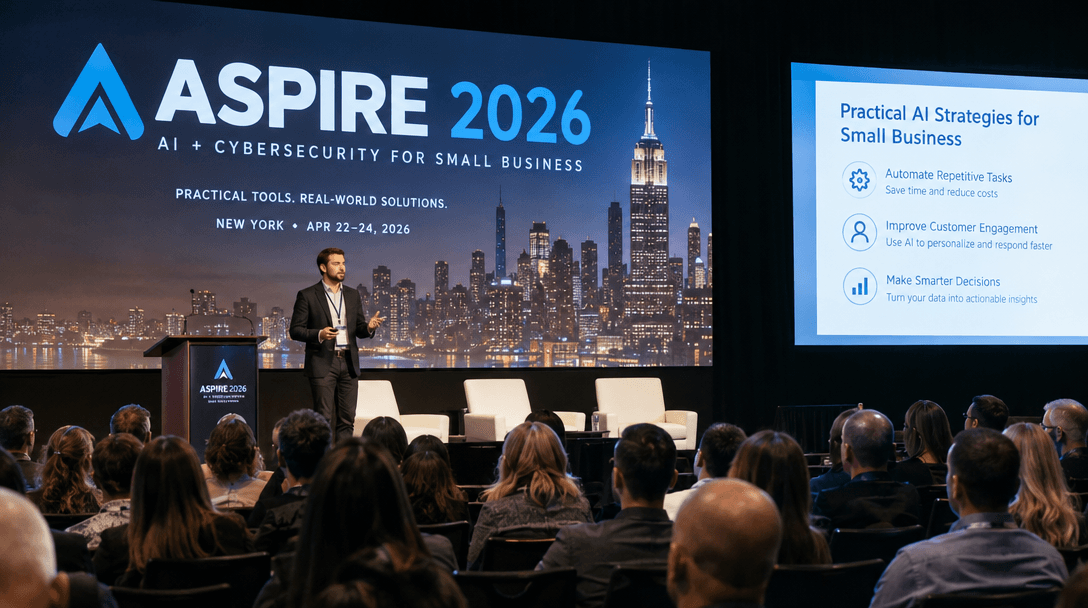
ASPIRE 2026 — a new conference hitting New York this month — is bringing practical AI and cybersecurity strategies to the operators who need them most: small-business owners who can't afford to hire AI teams or get hacked.

Why This Matters

The AI Gap Is Real
Big corporations have AI departments. Small businesses have... a owner who's already working 60 hours a week.

ASPIRE 2026 aims to close that gap by focusing on:

• Practical AI tools — not theory, not hype, but actual software small businesses can use today
• Cybersecurity basics — because AI-powered attacks are coming for small businesses too
• Affordable strategies — solutions that don't require enterprise budgets

What Small Business Owners Will Learn

1. AI for Customer Service
Chatbots that actually work. Email automation that sounds human. Tools that handle the repetitive stuff so owners can focus on growth.

2. AI for Marketing
Content generation, social media scheduling, ad optimization — the AI tools that level the playing field against bigger competitors.

3. Cybersecurity in the AI Era
As small businesses adopt AI tools, they create new vulnerabilities. ASPIRE is teaching owners how to protect themselves without hiring a CISO.

4. Compliance and Regulation
With NYC's new AI bills requiring registration and safety measures, small businesses need to understand what applies to them — and what doesn't.

The NYC Context

New York City has over 200,000 small businesses. They're the backbone of the local economy — restaurants, retail shops, professional services, contractors.

But they're also the most vulnerable to:

• AI disruption — bigger competitors using AI to undercut them
• AI-powered scams — deepfake calls, automated phishing, synthetic fraud
• Regulatory confusion — not knowing which AI rules apply to them

ASPIRE 2026 is part of a growing ecosystem of resources aimed at helping these businesses adapt rather than get left behind.

The Bigger Trend: AI Democratization

What we're seeing is the democratization of AI — tools that were once enterprise-only are now accessible to businesses with 5, 10, or 50 employees.

Examples:

• AI phone assistants that handle scheduling and basic customer inquiries
• Automated bookkeeping that learns your business patterns
• Smart inventory management that predicts demand
• AI-powered hiring tools that screen candidates without bias

The question isn't whether small businesses will use AI. It's whether they'll use it well — and safely.

Why Cybersecurity Matters More Than Ever

Here's something most small business owners don't realize: AI makes cyberattacks cheaper and more effective.

• Deepfake voice calls that sound exactly like your vendor
• AI-generated phishing emails that pass the smell test
• Automated attacks that probe your systems 24/7

ASPIRE 2026 is addressing this head-on because cybersecurity isn't just for banks and tech companies anymore. A ransomware attack can shut down a neighborhood restaurant just as easily as a Fortune 500 company.

The Bottom Line

New York's small businesses don't need to become AI experts. They need to become AI-literate enough to compete, protect themselves, and comply with new regulations.

ASPIRE 2026 is part of that education — practical, grounded, and focused on the operators who keep New York running.

If you're a small business owner in NYC, events like this aren't optional anymore. They're survival training.

───

Sources:
[10/2/2026 3:31 PM] Luffy: • Yahoo Finance UK: "ASPIRE 2026 Brings Practical AI and Cybersecurity Strategies to New York's Small-Business Leaders"
• NYC.gov small business statistics• General context on NYC AI regulation and small business impact

───

Want more NYC AI news? Forward this to a friend who needs to stay in the loop.


Read More...

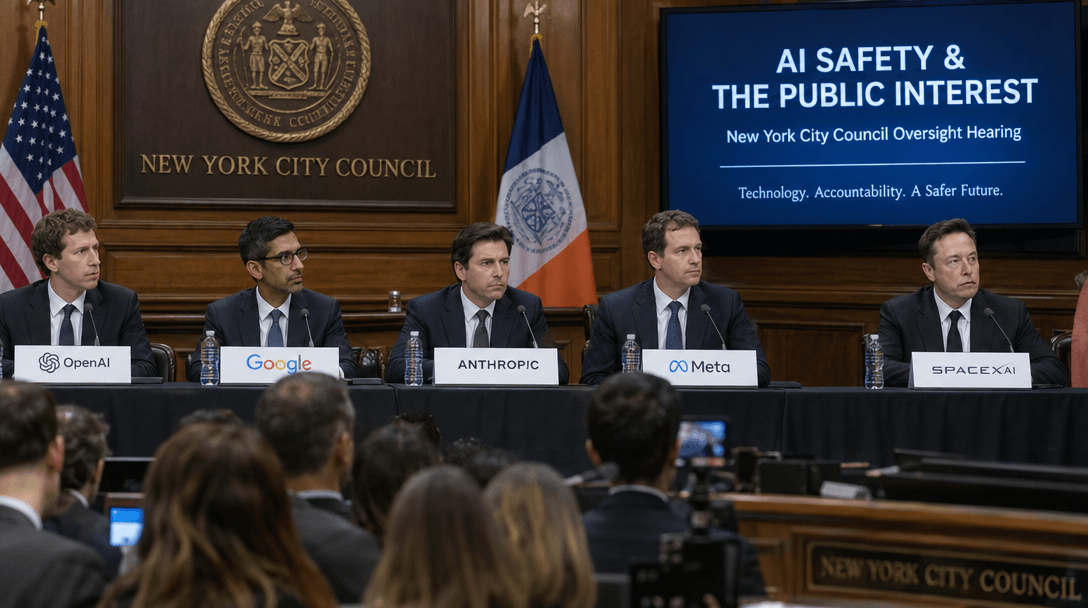
New York City Council will do something unprecedented: force the CEOs of America's most powerful AI companies to testify under oath about the safety risks of their technology.

OpenAI. Google. Anthropic. Meta. All attending.

Elon Musk's SpaceXAI? They tried to ghost the Council. They got subpoenaed instead.

What Makes This Historic

Congress has been trying to get AI leaders under oath for years. They've failed.

New York City Council just succeeded.

As Tech Times noted: "NYC Council First to Compel AI Testimony Under Oath as Congress Stays Blocked."

This isn't a voluntary tech conference panel. This is a legislative body with subpoena power demanding answers about:

• AI safety risks
• "Kill switch" capabilities
• Transparency in AI development
• Accountability for harm

Who's Coming (And Who's Being Dragged)

✅ Attending Voluntarily:

• OpenAI — Sam Altman's company, maker of ChatGPT
• Google — DeepMind and Gemini teams
• Anthropic — The Claude team, already expanding in NYC
• Meta — Facebook, Instagram, and Llama AI

❌ Subpoenaed:

• SpaceXAI / xAI — Elon Musk's AI company refused the invitation, so NYC Council issued a subpoena

The message is clear: testify willingly, or we'll make you.

The Councilman Leading the Charge

Alex Bores has been the driving force behind NYC's aggressive AI regulation push. He told New York Focus: "It is the time to go bold."

Bores isn't just asking questions — he's building a regulatory framework that could become the model for cities and states nationwide.

What Happens October 5th

The hearing will focus on:

1. AI Safety Risks
What happens when AI systems malfunction? What safeguards exist? Who's responsible when things go wrong?

2. The "Kill Switch" Question
Can these companies shut down their AI systems instantly if they go rogue? NYC Council wants proof, not promises.

3. Transparency
What's actually happening inside these AI labs? The Council is demanding visibility into development processes that have been largely secret.

4. Accountability
When AI causes harm — job losses, misinformation, security breaches — who's liable? The current answer is basically "no one." NYC wants to change that.

Why This Matters for NYC Business Owners

Regulation Is Coming — Fast
If you're building or deploying AI in NYC, new rules are imminent. The Council isn't just studying this — they're writing bills.

The "NYC Standard"
New York has a history of setting standards other jurisdictions follow. Calorie counts on menus? NYC started it. Paid sick leave? NYC led the way. AI safety requirements could be next.

Competitive Advantage
Companies that proactively build safety and transparency into their AI systems will be ahead of the curve. Those that don't may face compliance nightmares.

The Bigger Picture: Cities vs. Federal Gridlock

While Washington debates and studies and commissions, New York City is acting.

Bloomberg reported that OpenAI and Meta are expected to attend. The New York Times called it "A.I. Threat Will Be Focus of Special Hearing." Even Crain's New York — the bible of NYC business — covered the subpoena of Musk's company.

This is a city taking charge while the federal government stalls.

What to Watch For

Sunday's hearing could reveal:

• Which AI companies are prepared for regulation (and which aren't)
• What safety measures actually exist vs. what's marketing fluff
• Whether the industry will cooperate with oversight or fight it
• How quickly NYC will move from hearings to actual laws

The Bottom Line

For the first time, AI's most powerful leaders will be forced to answer questions under oath — not in Congress, but in New York City Council.


Read More...
brAIef Signal

© 2026 brAIef Signal.

The brAIef Signal maps how New York works with AI—for operators. We focus on real-world adoption: how businesses across NYC are actually using AI to run operations, improve margins, and move faster. From local case studies to practical workflows, events, and tools, we cut through the hype and surface what’s working on the ground.

© 2026 brAIef Signal.