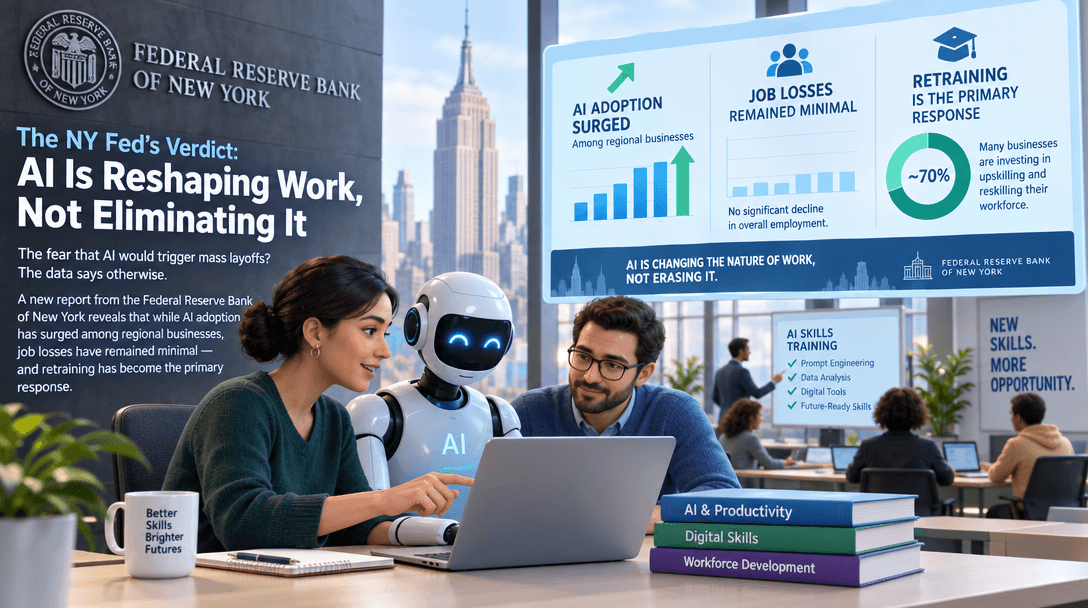
The NY Fed's Verdict: AI Is Reshaping Work, Not Eliminating It
The fear that AI would trigger mass layoffs? The data says otherwise.
A new report from the Federal Reserve Bank of New York reveals that while AI adoption has surged among regional businesses, job losses have remained minimal — and retraining has become the primary response.
───
The Numbers
According to the NY Fed's August business surveys:
• 61% of service firms now use AI (up from 40% in 2025)
• 51% of manufacturers have adopted AI (up from 26% last year)
• Only 4% of service firms laid off workers due to AI
• No manufacturers reported AI-related layoffs
• ~13% of service firms actually hired more workers to support AI initiatives
The median share of workers using AI within adopting firms? Just 17% at service firms and 7% at manufacturers — showing adoption is broad but not yet deep.
───
What Firms Are Actually Doing
Rather than cutting headcount, businesses are retraining existing workers:
• 35% of service firms report retraining employees for AI
• 20%+ of manufacturers are doing the same
• Training focuses on: AI literacy, prompt engineering, automating routine tasks, and responsible AI use (verifying outputs, understanding bias, data security)
Delivery methods vary widely — from formal workshops and external consultants to informal "show-and-tell" sessions and peer learning.
───
Why Some Firms Still Haven't Adopted
Cost isn't the main barrier. Among non-adopters:
• ~50% say their work doesn't lend itself to AI
• ~25% believe current AI isn't good enough for their needs
• ~35% have data privacy/security concerns
• ~35% lack staff with technical skills to implement AI effectively
───
The Bottom Line
Three years of NY Fed survey data confirm what emerging research shows: AI is augmenting workers, not replacing them — at least for now.
As the authors note: "Firms are continuing to adapt and change due to AI use, but not by eliminating vast numbers of jobs. Instead, this new technology is reshaping work itself."
That said, the report flags one potential concern: entry-level workers may face barriers as AI substitutes for routine tasks typically performed by newer employees.
───
Source: Liberty Street Economics — Jaison R. Abel, Richard Deitz, Natalia Emanuel, and Nick Montalbano, Federal Reserve Bank of New York, September 1, 2026.
───
The brAIef Signal — Mapping how New York works with AI.

Shinji Fuse
Sep 29, 2026

NYC Hospital Fires 12 Nurses, Replaces Them With AI What happened: Montefiore Medical Center in the Bronx laid off 12 utilization review nurses, replacing them with AI software from Datavant and just two doctors. The layoffs went into effect on September 1, 2026 — just months after those same nurses won historic AI safeguards in their contract through a 41-day strike. Why it matters: This appears to be the first major AI-related labor dispute in New York City healthcare, and it tests the enforceability of AI protections that unions are increasingly demanding. ─── The Backstory In January 2026, approximately 15,000 nurses across New York State launched a 41-day strike — one of the largest nursing strikes in U.S. history. The outcome: a new three-year contract that included what the New York State Nurses Association (NYSNA) called "historic safeguards against AI." The nurses returned to work in February. Then, without explanation, their workflow changed. In late May, the 12 Montefiore utilization review nurses received 45-day layoff notices. The layoffs became official on September 1, 2026. Utilization review nurses assess patient charts to verify that care is medically necessary for insurance coverage. When insurance companies deny claims, these nurses review patient charts, compare them to clinical criteria, and build the case for why care should be covered. It's specialized work that requires clinical judgment — exactly the kind of role proponents say AI "augments" rather than replaces. The Human Impact Marilyn Shuler had worked at Montefiore for 39 years before losing her job. "I've always, always taken so much pride in the organization that I've worked for all these years, and just to be treated this way. It's disrespectful, and it's very disheartening." Shaiju Kalathil, a Montefiore nurse and union committee member, called the move "a violation of the contract that we recently won by going on strike." The Technology The AI software replacing the nurses is from Datavant, a private-equity-backed health data company that also has partnerships with Palantir — the surveillance tech firm that has drawn controversy for its work with ICE. Montefiore disputes the union's framing. "The claims by NYSNA are inaccurate and misleading," said Joe Solmonese, senior vice-president for government relations. "We are always investing in new technology to ensure the best care and outcomes for our patients." The Clinical Risk A laid-off nurse, writing in the Bronx Times, explained why this matters for patients: "Many of our patients live with multiple chronic conditions, and often their charts don't match any standard template. Software programs aren't trained to assess these cases. Denials must be reversed by someone with decades of bedside experience navigating complicated cases. This type of judgement can't be programmed." The nurse's concern: insurance companies already deny claims aggressively. Without experienced nurses advocating for patients, more denials may go unchallenged — and patients in the Bronx, many with complex chronic conditions, will bear the cost. The Broader Context This isn't happening in a vacuum: • The CEO of NYC Health + Hospitals — the largest municipal healthcare system in the U.S. — has openly discussed replacing radiologists with AI What to Watch 1. Grievance outcome: NYSNA is challenging the layoffs as a contract violation. The resolution will set precedent for how AI protections in union contracts are enforced. 3. Regulatory response: New York has been relatively active on AI regulation. This case may accelerate legislation around AI workforce displacement in healthcare. The Operator's Take For NYC business owners watching AI adoption: this is what labor friction looks like when AI moves from "pilot project" to "headcount reduction." The nurses didn't oppose technology — they negotiated safeguards around it. When those safeguards were bypassed, the dispute escalated immediately. The lesson: if you're implementing AI in a way that affects roles, the compliance and labor relations work needs to happen before the deployment, not after. ─── Sources: • Futurism, "Health Care Workers Furious as NYC Replaces Nurses With AI" by Frank Landymore, July 15, 2026 Published in The brAIef Signal — Mapping how New York works with AI Read More... |

AI Just Got 50% Cheaper. Here's Why That Matters for Your Business. Read More... |
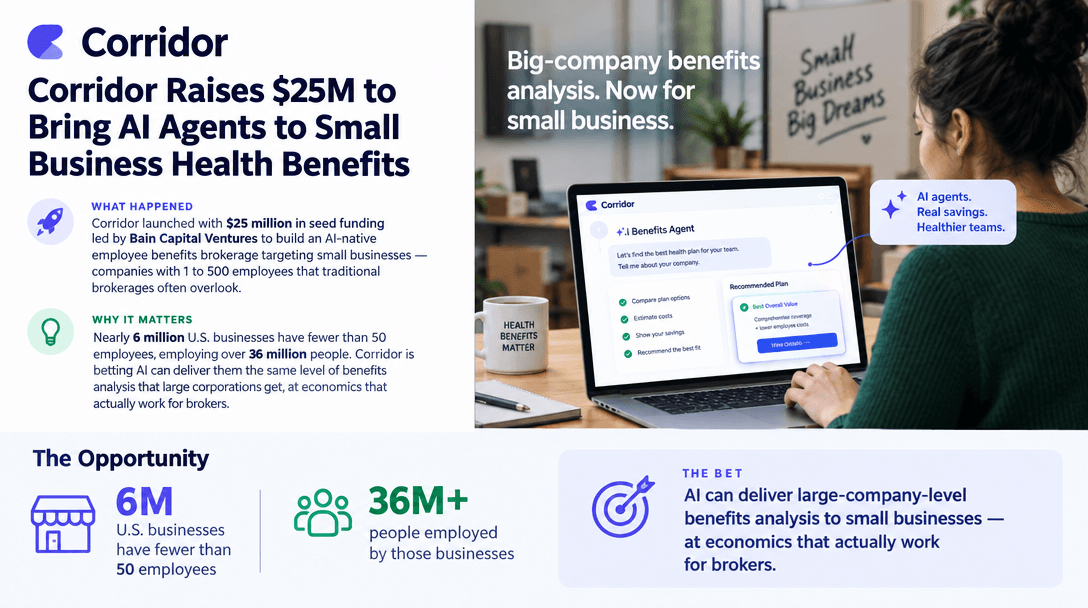
Corridor Raises $25M to Bring AI Agents to Small Business Health Benefits Read More... |
Read More... |