
NYC
Shinji Fuse

Shinji Fuse

Sep 26, 2026

0 Comments
AI Just Got 50% Cheaper—Who Wins When Intelligence Goes on Sale?

AI Just Got 50% Cheaper—Who Wins When Intelligence Goes on Sale?

A 50% price drop could reshape the tools you use—and the race to build what comes next.

S
Shinji Fuse· Sep 26, 2026
Share:

AI Just Got 50% Cheaper. Here's Why That Matters for Your Business.

The cost of intelligence is collapsing — and the implications go far beyond your API bill.

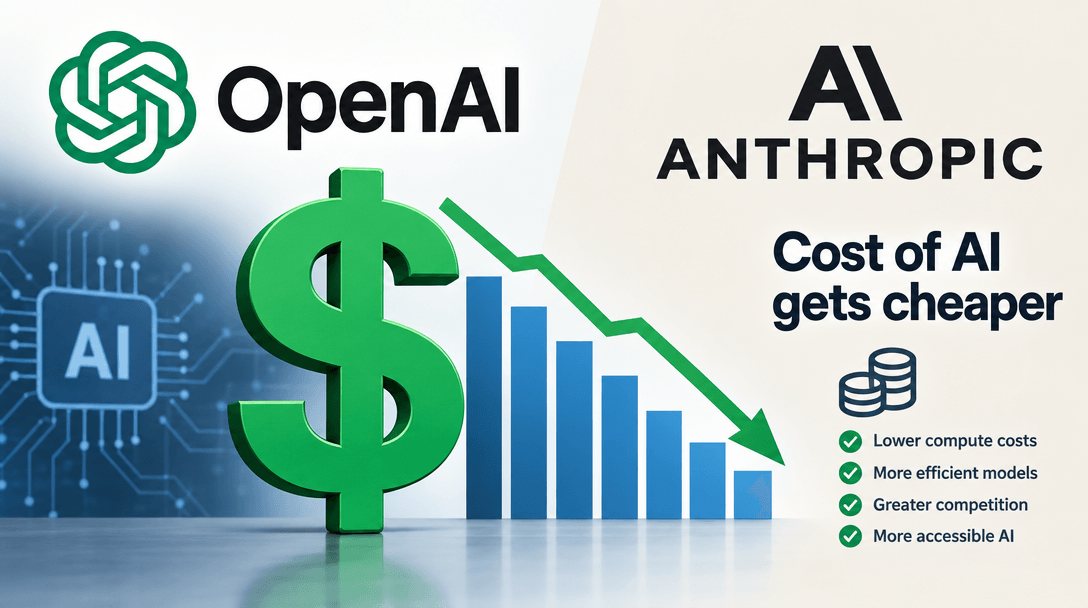
OpenAI and Anthropic both slashed prices this month, continuing a trend that's seen AI costs drop roughly 47% per quarter since 2023. For NYC businesses, this shifts the question from "Can we afford AI?" to "What can we build now that we couldn't before?"

───

The Price Cuts

OpenAI — GPT-6 Sol & Luna:

• GPT-6 Sol: 50% price drop — from $4 to $2 per million input tokens; $20 to $10 per million output tokens
• GPT-6 Luna: 50%+ cheaper — from $0.20 to $0.10 input; $1.20 to $0.50 output
• Driver: Better caching and inference efficiency

Anthropic — Claude Opus 5.5:

• 40% cheaper than Opus 5 on typical workloads
• 20% lower input/output prices
• 60% cheaper cached information reuse
• 30%+ faster response generation

───

The Bigger Picture

This isn't a pricing war — it's a capability unlock.

According to Epoch AI, the cost of achieving a given level of AI performance has fallen about 47% per quarter since 2023, equivalent to roughly 13-fold per year. That's not gradual improvement; that's a staircase.

What this means:

• Projects that were cost-prohibitive in Q2 are now viable in Q4
• AI-powered customer service, content generation, and data analysis are now accessible to businesses with smaller budgets
• The competitive moat shifts from "who can afford AI" to "who can implement it best"

───

The Infrastructure Paradox

Here's the counterintuitive part: cheaper AI doesn't mean less compute demand. It means more.

When intelligence gets cheaper, we use more of it. The same way cheaper electricity didn't reduce power consumption — it electrified everything.

For NYC's growing AI infrastructure (data centers, cloud regions, chip demand), this is bullish. For businesses, it means the window for early-mover advantage is closing fast.

───

The Bottom Line

The cost barrier to AI adoption just dropped again. Businesses that were waiting for the "right time" just ran out of excuses. The question is no longer whether AI fits your budget — it's whether your competitors are already using it to eat your lunch.

───

Source: AiNews.com — Alicia Shapiro, September 25, 2026.

───

The brAIef Signal — Mapping how New York works with AI.

0 Comments

Join the conversation

Be the first to comment

Share your thoughts above.

brAIef Signal

© 2026 brAIef Signal.

The brAIef Signal maps how New York works with AI—for operators. We focus on real-world adoption: how businesses across NYC are actually using AI to run operations, improve margins, and move faster. From local case studies to practical workflows, events, and tools, we cut through the hype and surface what’s working on the ground.

© 2026 brAIef Signal.