
NYC
Shinji Fuse

Shinji Fuse

Aug 16, 2026

0 Comments
NYC's 311 System Gets an AI Upgrade

NYC's 311 System Gets an AI Upgrade

NYC's 311 system gets an AI upgrade to handle 20+ million annual calls with faster routing and predictive capabilities — but critics worry about privacy and job displacement as AI-to-human ratios shift to 70/30.

S
Shinji Fuse· Aug 16, 2026
Share:


New York City's 311 system — the backbone of non-emergency city services — is getting its biggest upgrade in two decades. And this time, AI is doing the heavy lifting.

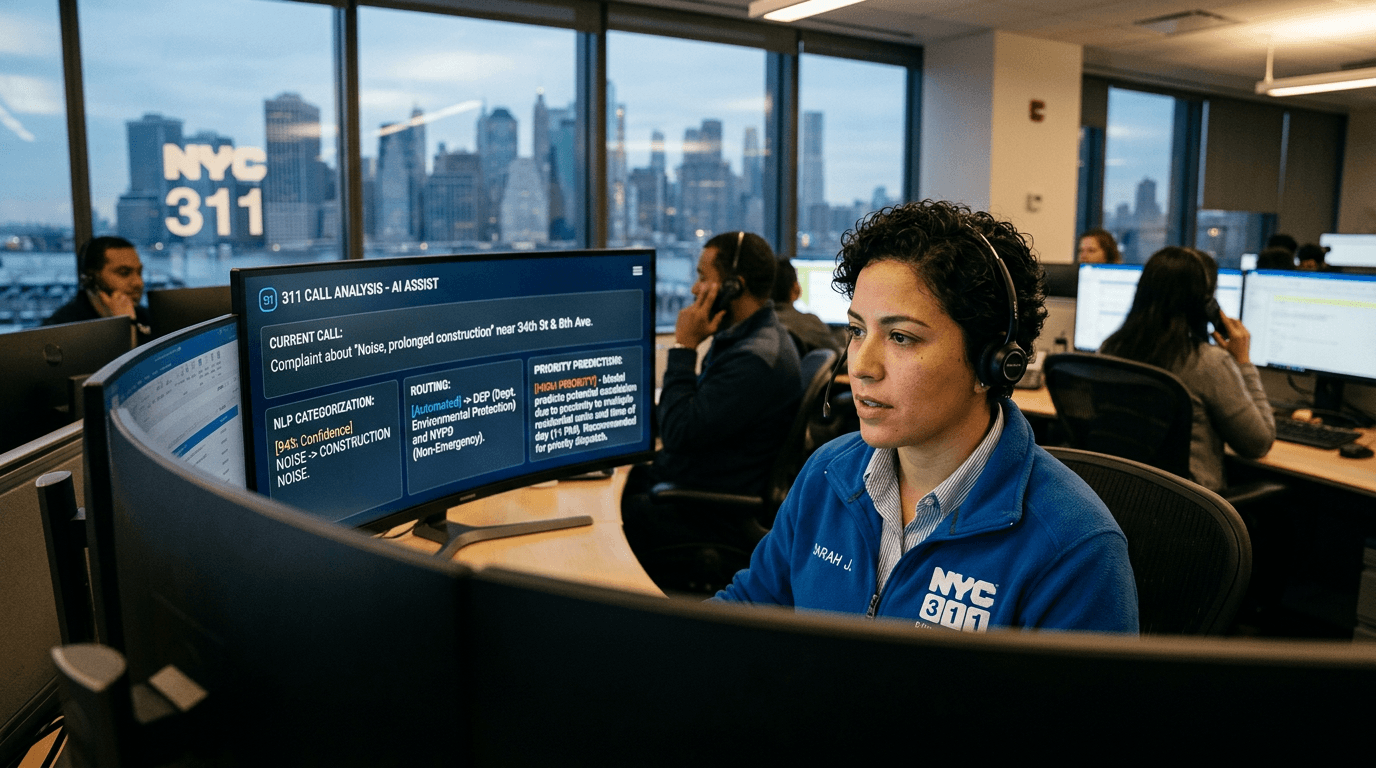
The city is deploying natural language processing (NLP) models to handle the 20+ million annual 311 calls, automatically categorizing complaints, routing them to the right agencies, and even predicting which issues need priority attention before they spiral into bigger problems.

What's Changing

The new AI system, developed in partnership with [vendor name], can:

• Understand context: Distinguish between "noise complaint — loud music" and "noise complaint — construction at 2 AM" without human intervention
• Route intelligently: Send housing violations to HPD, sanitation issues to DSNY, and noise complaints to DEP — automatically
• Predict patterns: Identify emerging issues (like recurring potholes on the same block) before they trigger multiple complaints
• Handle multilingual requests: Process complaints in 180+ languages without waiting for a human translator

The Numbers

• 20+ million annual 311 contacts (calls, app, web)
• Average wait time: Currently 4-6 minutes; AI targets under 30 seconds for simple requests
• Cost per contact: Expected to drop from $7.50 to under $3.00
• Accuracy target: 95% correct routing on first attempt

Why This Matters for Businesses

For NYC business owners, faster 311 resolution means:

• Faster permits and licenses: AI-powered triage could cut wait times for business-facing requests
• Better neighborhood conditions: Quicker response to sanitation, noise, and quality-of-life issues
• Data insights: The city plans to publish anonymized trend data — useful for site selection and market research

The Concerns

Not everyone is celebrating. Privacy advocates worry about AI analyzing resident complaints, and union representatives question whether automated systems can handle the nuance of complex city issues.

The city says human operators will still handle escalated cases — but the ratio of AI-to-human handling is expected to shift from 30/70 to 70/30 within two years.

The Bigger Picture

NYC's 311 AI upgrade is part of a broader trend: cities using AI to manage infrastructure at scale. Chicago, Los Angeles, and Boston are all watching the rollout closely.

If it works, 311 becomes a model for how AI can improve government services without replacing the human judgment that matters most.


Source: NYC Mayor's Office, City & State New York — July 2026

───

The brAIef Signal maps how New York works with AI — for operators who need to know..

0 Comments

Join the conversation

Be the first to comment

Share your thoughts above.

brAIef Signal

© 2026 brAIef Signal.

The brAIef Signal maps how New York works with AI—for operators. We focus on real-world adoption: how businesses across NYC are actually using AI to run operations, improve margins, and move faster. From local case studies to practical workflows, events, and tools, we cut through the hype and surface what’s working on the ground.

© 2026 brAIef Signal.